FSSAI Advertising and Claims Regulations: Food Claims Guide
A food advertisement may look creative and persuasive, but one inappropriate claim can turn a marketing campaign into a regulatory compliance issue.
In India, food businesses and marketers need to ensure that claims made on product labels, websites, social media, e-commerce listings, advertisements and other marketing communications comply with the Food Safety and Standards Act, 2006 and applicable FSSAI regulations, particularly the Food Safety and Standards (Advertising and Claims) Regulations, 2018, as amended.
For food brands, manufacturers, importers, nutraceutical companies and marketing teams, claim compliance therefore needs to be considered before a campaign goes live, rather than only when the final food label is prepared.
What Does FSSAI Require From a Food Claim?
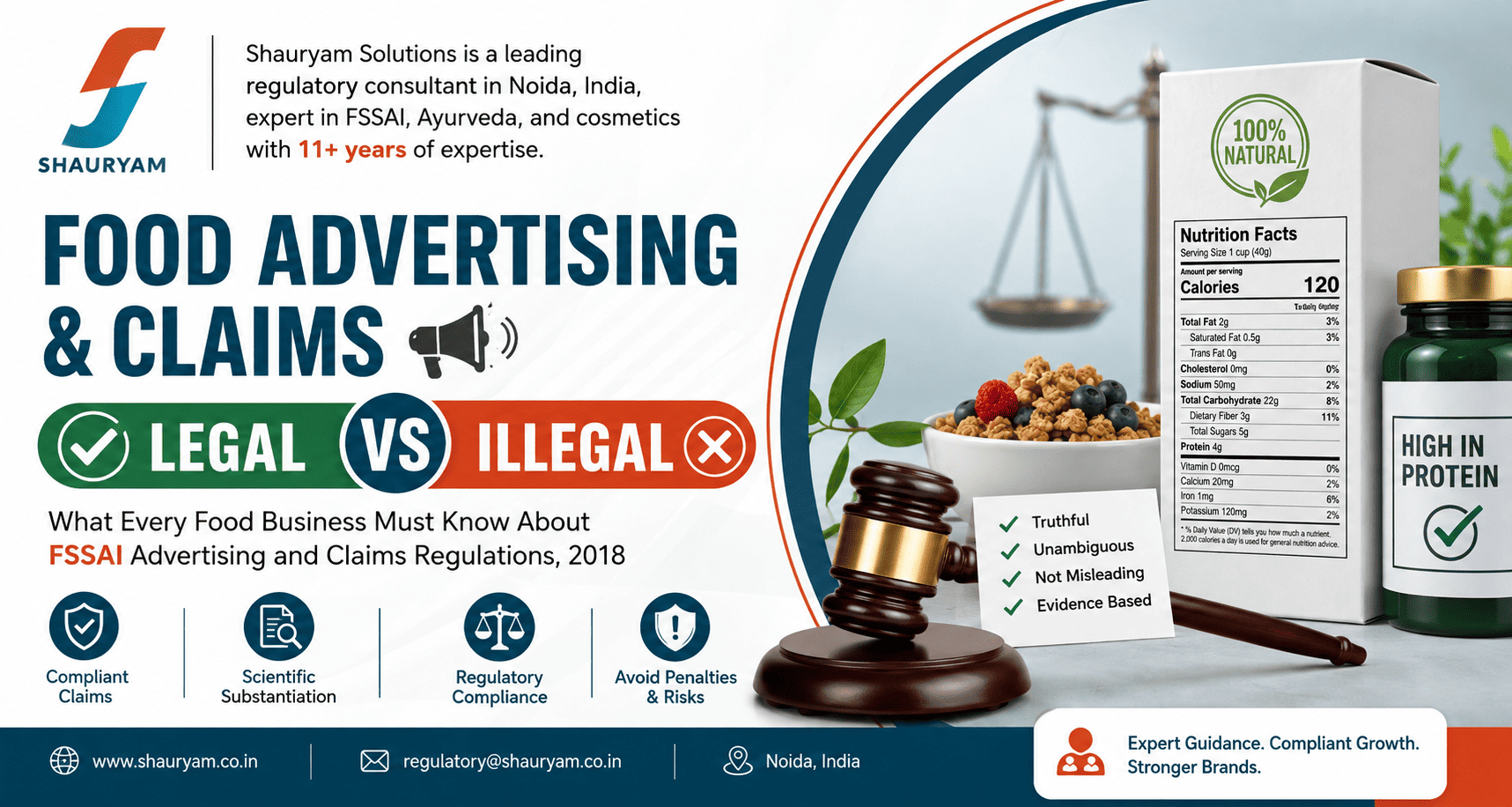
Under Regulation 4 of the Advertising and Claims Regulations, claims must be:
- Truthful
- Unambiguous
- Meaningful
- Not misleading
- Presented in a manner that helps consumers understand the information provided
Claims must also not encourage or condone excessive consumption of a particular food or suggest that a balanced and varied diet cannot provide appropriate quantities of nutrients required by the body.
Importantly, disclaimers connected with claims must be conspicuous and legible.
This means a technically correct statement may still create a compliance problem if the overall presentation, wording or context gives consumers a misleading impression.
1. Nutrition Claims: Conditions Matter
Statements such as:
“Source of Protein”
“High in Fibre”
“Low Fat”
“Sugar Free”
should not be treated merely as marketing language.
These are regulated nutrition claims.
The food must satisfy the applicable conditions prescribed under the Advertising and Claims Regulations or other applicable FSSAI regulations before the corresponding claim is used.
For example, a brand should not use “high in fibre” simply because fibre appears in the nutrition information. The product needs to satisfy the prescribed condition applicable to that claim.
The same principle applies to terms such as “free,” “low,” “source,” “high,” “reduced” and “increased.”
Compliance takeaway
Product formulation → analytical/nutritional data → regulatory criteria → claim wording
The claim should follow the evidence and applicable regulatory standard, not the other way around.
2. Health Claims Require Greater Scrutiny
Health-related food claims need particularly careful evaluation.
Under the regulations, nutrient-function and other function claims must be supported by current and relevant scientific substantiation and sufficient evidence concerning the claimed effect and its relationship to health.
Where applicable, additional information may also be necessary, including:
- Quantity of the nutrient/substance that is the subject of the claim
- Target group
- Appropriate directions for use
- Advice for vulnerable groups where relevant
- Maximum safe intake, where necessary
Scientific substantiation should also be reviewed as scientific knowledge develops.
Therefore, having some scientific evidence does not automatically make every proposed health claim compliant.
3. Disease Prevention, Treatment and Cure Claims Are a Major Red Flag
Consider:
“This drink prevents diabetes.”
This should not be treated as an ordinary health claim that becomes acceptable merely because a company possesses a study supporting an ingredient.
FSSAI’s Advertising and Claims Regulations prohibit claims referring to a food’s suitability for the prevention, alleviation, treatment or cure of a disease, disorder or particular physiological condition, unless specifically permitted under other regulations made under the Food Safety and Standards Act.
This distinction is particularly important for:
- Health supplements
- Nutraceuticals
- Functional foods
- Foods for Special Dietary Use (FSDU)
- Foods for Special Medical Purpose (FSMP)
- Fortified or functional food products
The regulatory category of the product and the applicable product-specific regulations must therefore be reviewed before finalising health-related marketing communication.
4. When Is Prior FSSAI Approval Required for a Claim?
Not every food claim requires individual prior approval from FSSAI.
This is an important distinction.
However, under Regulation 11, a food business operator or marketer must seek prior approval from the Food Authority for a reduction-of-disease-risk claim other than one already defined and for which criteria are laid down under the Advertising and Claims Regulations or another regulation under the FSS Act.
The approval process can require information including:
- Proposed claim
- Relevant ingredient, nutrient or substance
- Validated analytical method
- Scientific substantiation
- Explanation of how the claim is clear and meaningful
- Appropriate human intervention studies for health claims
- Other information considered relevant
Brands should therefore avoid assuming that scientific literature alone provides regulatory permission to introduce a new disease-risk-reduction claim.
5. Be Careful With “Natural”, “Pure”, “Fresh” and Similar Terms
Words such as:
Natural | Fresh | Pure | Original | Traditional | Authentic | Genuine | Real
can influence how consumers perceive a food product.
FSSAI therefore regulates their use.
These terms must satisfy the applicable conditions prescribed under the Advertising and Claims Regulations.
There is also an important issue involving brand names and trademarks.
Where a trademark, brand name or fancy name containing such terminology could mislead consumers regarding the true nature of the food, an applicable disclaimer may be required on the label in the prescribed manner.
So having a word registered as part of a trademark does not automatically eliminate food-claim compliance considerations.
6. The “100%” Claim: An Important FSSAI Advisory
Food businesses should pay particular attention to the expression:
“100%”
In May 2025, FSSAI issued an advisory asking Food Business Operators to refrain from using the term “100%” on food product labels, packaging and promotional content.
FSSAI noted that “100%” is not defined or referenced under the existing FSS Act, Rules or Regulations and expressed concern that its use could create an impression of absolute purity or superiority and potentially mislead consumers.
Therefore, expressions such as:
“100% Pure”
“100% Natural”
“100% Healthy”
should not be adopted simply because they are common marketing expressions.
This advisory remains an important consideration when reviewing food marketing communication in 2026.
7. Can the FSSAI Logo or Licence Number Be Used as a Marketing Endorsement?
This area is frequently misunderstood.
The FSSAI logo and licence number have mandatory display requirements on food labels under applicable labelling regulations.
However, the Advertising and Claims Regulations specifically provide that no claim or promotion of the sale, supply, use or consumption of food should be made using the FSSAI logo and licence number.
In simple terms:
Displaying regulatory information because the law requires it is different from using it to imply:
“FSSAI recommends our product”
“FSSAI approved for better health”
“Buy this because it is FSSAI certified”
A food licence should not be presented as an endorsement of the product’s quality, health benefit or superiority.
8. Claims Must Remain Consistent Across Label and Advertising
Claim compliance should not stop at the packaging artwork.
Businesses should review claims across:
- Product labels
- Websites and landing pages
- Social media posts
- Digital advertisements
- E-commerce product listings
- Marketplace images
- Influencer/promotional communication
- Brochures and sales materials
A conservative label cannot necessarily protect a brand if its digital advertisement makes an exaggerated or misleading representation.
Marketing and regulatory teams therefore need to work from the same approved claim framework.
9. Comparative Advertising Also Has Rules
A company may wish to communicate that its product contains more or less of a nutrient than another product.
Such comparative claims are not automatically prohibited, but they need to satisfy the applicable regulatory conditions.
The comparison should be meaningful and should not mislead consumers.
FSSAI regulations also prohibit advertisements or claims that undermine another manufacturer’s food product for the purpose of promoting one’s own product or influencing consumer behaviour.
10. “Recommended by Doctors” Can Create a Compliance Problem
Food brands should also be cautious about medical endorsement language.
The regulations prohibit food labels from carrying statements such as “recommended by medical or nutrition or health professionals”, or wording implying that the food is recommended, prescribed or approved by medical practitioners or approved for medical purposes.
This is particularly important for nutraceutical and health-focused brands, where marketing teams may be tempted to use medical-style positioning.
11. Advertising Should Not Encourage Excessive Consumption
Compliance is not limited to individual words.
The overall advertising message matters.
Claims must not encourage or condone excessive consumption of a particular food, and advertisements should not undermine the importance of healthy lifestyles.
Therefore, the visual, headline, supporting copy and overall consumer impression should be evaluated together.
A Practical Food Claim Compliance Check
Before releasing a food advertisement or approving a new packaging claim, businesses can ask:
Q. Is the claim truthful?
Can the business substantiate what is being communicated?
Q. Is the claim specifically regulated?
Check whether it is a nutrition, health, non-addition, comparative, conditional or disease-risk-reduction claim.
Q. Does the product actually satisfy the applicable conditions?
Do not rely only on marketing interpretation.
Q. Is adequate scientific substantiation available where required?
Evidence should correspond to the actual claim and product context.
Q. Is the claim consistent with the label and product composition?
Marketing communication should not create a contradictory impression.
Q. Could an average consumer misunderstand the claim?
Consider the complete advertisement—not merely an isolated sentence.
Q. Is prior FSSAI approval required?
This becomes particularly important for certain reduction-of-disease-risk claims.
Q. Are the required disclaimers present and appropriately displayed?
A disclaimer should not be used as a hidden mechanism to correct an otherwise misleading headline.
Q. Are words such as “100%”, “natural”, “pure”, “fresh” or similar descriptors being used appropriately?
These expressions deserve specific regulatory review.
Q. Is the FSSAI logo/licence information being used only in the legally appropriate manner?
Do not turn a regulatory licence into a promotional endorsement.
What Can Happen if an Advertisement Is Misleading?
Under Section 53 of the Food Safety and Standards Act, 2006, a person who publishes, or is a party to the publication of, an advertisement that falsely describes a food or is likely to mislead as to its nature, substance or quality, or gives a false guarantee, can be liable to a penalty which may extend to ₹10 lakh.
The Advertising and Claims Regulations also establish a mechanism for addressing non-compliant or misleading claims.
Compliance therefore needs to be considered before the campaign reaches consumers.
Why Food Claim Compliance Matters in 2026
Today’s food advertisement is no longer limited to television or print.
A claim can appear simultaneously on a product package, Instagram creative, LinkedIn campaign, website, marketplace listing, influencer video and e-commerce banner.
That makes regulatory consistency increasingly important.
A claim that sounds commercially attractive may fall under a very specific regulatory definition.
For food businesses, the safer process is:
Formulation Review → Product Categorisation → Label Review → Claim Validation → Advertisement Review → Release
rather than developing the marketing claim first and checking compliance afterwards.
Conclusion
Food advertising compliance is not about eliminating creativity from marketing.
It is about ensuring that creativity does not transform a legitimate product benefit into a misleading consumer promise.
Under India’s food regulatory framework, nutrition claims, health claims, comparative claims, conditional claims and disease-risk-reduction claims can have different requirements.
Before publishing a claim, food businesses should verify the product category, formulation, applicable FSSAI regulation, prescribed claim conditions, scientific substantiation, label consistency and overall consumer impression.
For manufacturers, food brands, importers, relabellers and nutraceutical businesses, regulatory review at the pre-launch stage can significantly reduce avoidable compliance issues later.
How Shauryam Solutions Can Support Food Businesses
Shauryam Solutions Private Limited supports food and nutraceutical businesses with regulatory advisory covering areas such as:
- FSSAI regulatory compliance
- Product categorisation and formulation review
- Food label compliance
- Nutrition and health claim validation
- Advertising and promotional claim review
- Nutraceutical regulatory assessment
- India-entry and import compliance
With 11+ years of regulatory experience, an expert regulatory team and experience serving 1000+ clients globally, Shauryam helps businesses evaluate food products and marketing communication against applicable Indian regulatory requirements.
Planning a new food product, label or advertising campaign? Connect with Shauryam’s regulatory experts before your claims go live.
People Also Ask
Certain health claims may be made subject to the conditions prescribed under applicable FSSAI regulations. The exact claim, product category, composition and scientific substantiation should be evaluated before use.
As a general rule, claims relating to prevention, alleviation, treatment or cure of disease are prohibited unless specifically permitted under applicable regulations. Such statements should not be treated as ordinary marketing claims.
No. Claims that satisfy criteria already prescribed under applicable regulations do not automatically require individual prior approval. However, certain reduction-of-disease-risk claims outside the claims already defined and prescribed require prior approval from the Food Authority.
FSSAI’s May 2025 advisory asked FBOs to refrain from using the term “100%” on food labels, packaging and promotional content because of its potential to mislead consumers.
Yes. The FSSAI logo and applicable licence number are required to be displayed in accordance with the Labelling and Display Regulations. However, they should not be used to promote the sale, supply, use or consumption of the food or to imply FSSAI endorsement.
No. The product must satisfy the applicable regulatory criteria for the relevant nutrition claim before it is used.
Food advertising and marketing communications are subject to the applicable advertising and claims requirements. Businesses should therefore review claims used across digital advertising, websites, social media and e-commerce communication, not just physical labels.
Regulatory Note
This article is intended for general regulatory awareness and should not be treated as legal advice. Requirements can depend on the product category, formulation, intended claim and applicable FSSAI regulations, directions, orders and amendments. Businesses should verify the latest official requirements applicable to their specific product before commercial use.