India’s food regulatory space has just undergone its most significant overhaul in over a decade. On 13th March 2026, the Food Safety and Standards Authority of India issued an official Order implementing revised FSSAI turnover thresholds for food business operators (FBOs) across the country, backed by the Gazette Notification No. RCD-01002/1/2021-Regulatory-FSSAI-Part(1) dated 10.03.2026. The new thresholds are set to come into force from 1st April 2026 and will fundamentally reshape how millions of food businesses in India obtain and maintain their FSSAI Registration, State License, or Central License.
Whether you run a home bakery, cloud kitchen, a street food stall, a restaurant chain, or a large-scale food manufacturing unit, this update directly impacts your compliance obligations. At Shauryam Solutions Private Limited, we break down every critical aspect of this regulatory change to help food business operators stay compliant and avoid penalties.
Background: Why FSSAI Revised the Turnover Thresholds
The Food Safety and Standards (Licensing and Registration of Food Businesses) Regulations, 2011 originally laid down the framework for categorising food business operators (FBOs) for the purpose of FSSAI registration and licensing. However, with India’s food economy expanding rapidly and inflation eroding the relevance of older thresholds, the need for an update had long been felt.
Based on recommendations from NITI Aayog’s High Level Committee on Non-Financial Regulatory Reforms and with the approval of the Ministry of Health and Family Welfare, FSSAI notified the Food Safety and Standards (Licensing and Registration of Food Businesses) Amendment Regulations, 2026 vide Gazette Notification No. RCD-01002/1/2021-Regulatory-FSSAI-Part(1) dated 10.03.2026.
This FSSAI amendment introduces several forward-thinking provisions including: dual compliance requirements for street food vendors, perpetual validity of FSSAI license and registration, risk-based inspection mechanisms, and the authority for FSSAI to specify turnover thresholds for different food businesses from time to time.
What Has Changed: A Detailed Breakdown
1. Revised FSSAI Turnover Thresholds (Effective 01.04.2026)
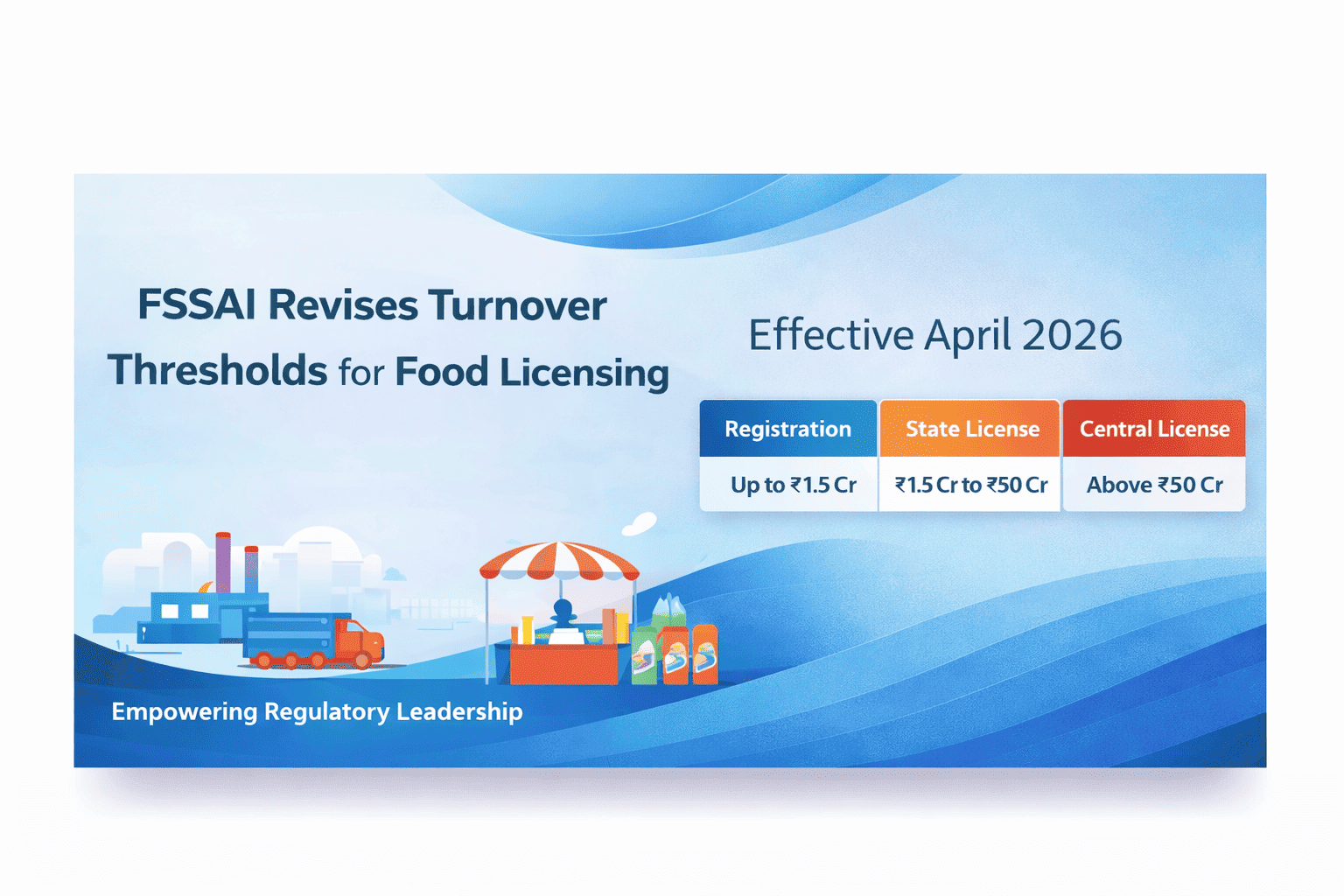
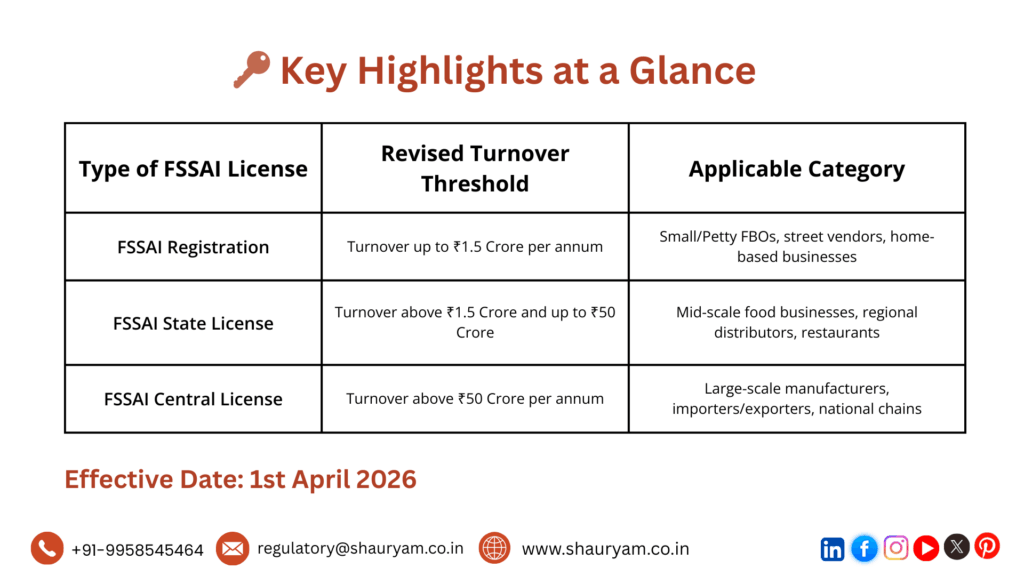
The most consequential change in the FSSAI 2026 amendment is the revision of turnover-based categorisation. The revised structure expands the scope of FSSAI registration while also adjusting the Central License requirement upward.
Here’s what this means for every food business operator:
- FSSAI Registration (up to ₹1.5 Crore turnover): Ideal for small food businesses, home kitchens, cloud kitchens, tiffin services, petty food vendors, street food vendors, hawkers, food carts, food trucks, and micro food enterprises.
- FSSAI State License (₹1.5 Crore to ₹50 Crore turnover): Applicable to medium-scale food manufacturers, regional restaurant chains, cold storage operators, food distributors, and catering services with significant operations within one state.
- FSSAI Central License (above ₹50 Crore turnover): Required for large food manufacturers, importers and exporters of food products, pan-India food chains, dairy and meat processing units, and 100% EOU (Export Oriented Units).
2. Perpetual Validity of FSSAI License and Registration
One of the most business-friendly changes in the FSSAI 2026 amendment is the introduction of perpetual validity for FSSAI registration and license. Unlike earlier where renewals were mandatory after a fixed period, the new Regulation 2.1.7 specifies that a license or registration certificate granted shall be valid and subsisting unless otherwise suspended, cancelled, or surrendered.
However, food business operators must note that non-payment of annual FSSAI license fee or failure to submit the Food Safety Compliance Return (FSCR) on the due date will result in deemed suspension of the license or registration. The FSSAI license so suspended will be revoked only after payment of dues and applicable penalties.
3. Street Food Vendors: Dual Compliance and Deemed Registration
A landmark provision in the FSSAI amendment regulations 2026 is the deemed registration of street food vendors and hawkers registered under the Street Vendors (Protection of Livelihood and Regulation of Street Vending) Act, 2014 (7 of 2014). Such vendors shall be considered to have met their FSSAI registration requirement under the Food Safety and Standards Act, 2006.
This is a major relief for millions of street food vendors across India. However, all such food business operators, whether formally registered or deemed registered (including exempted categories), must comply with the hygiene and sanitary requirements specified in Schedule 4 of the FSSAI regulations.
4. Instant FSSAI Registration Certificate
The amendment also introduces the provision for instant FSSAI registration upon submission of requisite documents. The Food Authority may grant the FSSAI registration certificate instantly and may specify any condition or procedure for this purpose. This aims to reduce the compliance burden on petty food business operators and encourage formalisation.
5. Expanded Definition of Petty Food Business Operator
The FSSAI 2026 notification has updated the definition of “Petty Food Business Operator” under Regulation 1.2.1(4) to explicitly include: food trucks, food carts, temporary stall holders, itinerant vendors, hawkers, street food vendors, and those distributing food at religious or social gatherings (except caterers). This provides greater legal clarity for a large and previously ambiguous category of FBOs.
6. Risk-Based Inspection and Third-Party Audit Framework
A brand-new Regulation 2.1.17 has been inserted into the FSSAI regulations, establishing a structured periodic inspection and food safety audit framework.
Key features include:
- The Food Authority will ensure periodic inspections through its own machinery or authorised agencies.
- Inspection frequency will be determined through a dynamic risk-based mechanism considering type of food business, past compliance history, third-party audit results, and risk category of food handled.
- The Commissioner of Food Safety in each state will prepare inspection plans based on food and establishment risk levels.
- FBOs may be directed to get a food safety audit done by FSSAI-recognised third-party auditing agencies at their own cost.
Who Is Most Affected by the FSSAI Turnover Threshold Change?
The revised FSSAI turnover threshold affects the following food business operators most directly:
- Micro & Small Manufacturers: Those previously holding State License with turnover under ₹1.5 Crore may now qualify for simple FSSAI Registration.
- Mid-Scale Businesses (₹1.5Cr–₹50Cr): The revised State License band now covers a much wider range, requiring many businesses to upgrade from Registration to State License.
- Large Food Companies (above ₹50Cr): The Central License threshold raised to ₹50 Crore benefits many national-level brands.
- Street Food Vendors & Hawkers: Deemed FSSAI registration under the Street Vendors Act, 2014 brings clarity and relief for this sector.
- Home-Based Food Businesses: Cloud kitchens, tiffin services, home bakers with turnover under ₹1.5 Crore need only FSSAI Registration.
- Food Trucks: Now explicitly included under the Petty FBO definition, bringing clarity on their licensing category.
- Catering Businesses: Excluded from the Petty FBO definition; must separately evaluate their applicable license category.
Action Checklist for Food Business Operators (FBOs)
Before 1st April 2026, every FBO must:
- Calculate your current annual turnover from food business operations to determine the applicable FSSAI license category.
- Check whether you currently hold an FSSAI Registration, State License, or Central License, and whether a re-categorisation is needed.
- If your turnover has crossed ₹1.5 Crore, apply for an FSSAI State License upgrade immediately.
- If your turnover has crossed ₹50 Crore, ensure a Central License is in place.
- Ensure your annual FSSAI license fee is paid and your Food Safety Compliance Return (FSCR) is submitted on time to avoid deemed suspension.
- Street food vendors: verify your registration under the Street Vendors Act, 2014 and ensure compliance with Schedule 4 hygiene standards.
- Review your food safety audit obligations under the new Regulation 2.1.17.
- In case of business closure, inform the Licensing/Registration Authority in writing within 30 days and surrender your FSSAI license or registration.
Gazette Notification Reference
This blog is based on the official Gazette of India: Extraordinary, Part III, Section 4, published on March 11, 2026 (Phalguna 20, 1947), bearing Gazette No. 172. The notification number is CG-DL-E-12032026-270872. The implementing order was issued by FSSAI CEO Rajit Punhani on 13th March 2026.
The amendment was signed off under FSSAI’s authority derived from Clause (o) of Sub-section (2) of Section 92 read with Section 31 of the Food Safety and Standards Act, 2006, with prior approval of the Central Government.
What is the new FSSAI turnover threshold for Registration in 2026?
What is the revised turnover limit for FSSAI State License in 2026?
When is the FSSAI new turnover threshold applicable from?
Do I need to change my FSSAI license if my turnover category changes after April 2026?
Do street food vendors need a separate FSSAI registration?
Is FSSAI registration now permanent/lifetime valid?
How Shauryam Can Help
Managing FSSAI compliance – from determining the right license category based on your turnover, to filing returns, managing audits, and staying updated on regulatory changes – can be complex and time-consuming. Shauryam Solutions Private Limited offers end-to-end FSSAI licensing and registration services, compliance audits, and regulatory advisory tailored to food businesses of all sizes.
- FSSAI Registration, State License & Central License applications
- FSSAI License upgrades and modifications
- Food Safety Management System (FSMS) advisory
- Regulatory compliance training for food business teams
- Third-party food safety audit facilitation
- Legal compliance review aligned with FSSAI 2026 amendment regulations
Connect with our FSSAI experts today to ensure your food business is fully compliant before 1st April 2026.